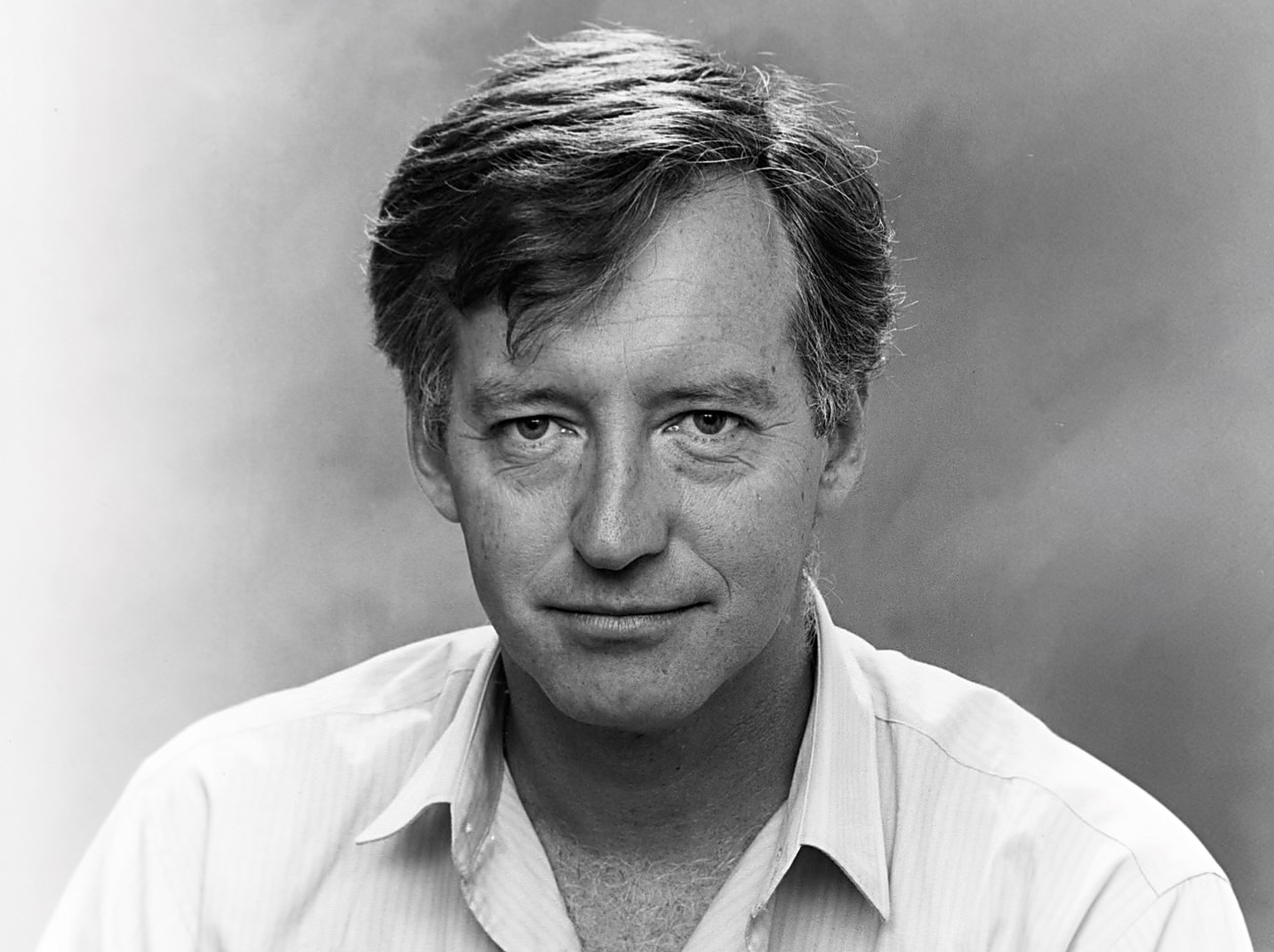
Peter Manning, a giant of Australian journalism, died in Sydney on Monday 28 September after a short illness. His funeral will be at 10.30am at St Brigid’s Church, Marrickville on Friday 9 October.
Jonathan Holmes, who worked with and for him, off and on, for over a decade, has written a personal recollection of Peter the man and his outstanding career.
In April 1982 I arrived from England to take over as executive producer of Four Corners. I knew almost nothing about Australia, and none of the team with whom I would be working. I expected a fair amount of hostility towards this Pommie imposter.
Instead, on my second weekend in Sydney, the program’s sole producer, a tall, lanky bloke called Peter Manning, invited me on a trip to the Blue Mountains with his partner Jenny Brockie and some others, “to have a look at the autumn foliage”.
To an Englishman facing up to his second winter in a row, the foliage was not that impressive. In fact, I found the forest of grey-green eucalypts that surrounded the few splashes of red and brown both dull and oppressive. The birds in the gum trees were huge and almost alarmingly raucous. You have to learn to love the Australian bush.
Still, it was a typically generous gesture by Peter, not diminished in the least by the relish with which, in a game of bush cricket that he instigated, he bowled me for a golden duck with a ball that Dennis Lillee would have been proud of.
He was man who loved Australia and loved life.
Towards the end of that first year, I recruited a rural reporter I liked the look of, an honest-looking, Aussie-sounding reporter from the rural department called Chris Masters. His brother Roy was a famous rugby league coach, so when Chris suggested that his first program should look at money and corruption in the sport, I paired him with Manning – already an investigative reporter of some note – and told them to go for it.
The program they came up with months later, The Big League, put Four Corners on the map for the rest of the 1980’s. The Street Royal Commission found that the then premier of New South Wales, Neville Wran, had not urged the state’s chief magistrate to secure the dismissal of a charge of fraud brought against the President of the NSW Rugby League. It did find that, just as the program had related, the chief magistrate, Murray Farquhar, had used the premier’s name to get the charge dismissed.
Farquhar went to prison, Chris Masters was launched on a career as Australia’s foremost television investigator – and Peter Manning became my right-hand man and obvious successor when I left the program in 1985. We were able to recruit some stellar names to our reporting team – Kerry O’Brien, Andrew Olle, and Jenny Brockie in my time. Peter went on to hire, among others, Paul Barry, Mark Colvin, Tony Jones, David Marr, Deb Snow and Marian Wilkinson. Behind the camera, his producers and researchers would become almost as well-known, at least within the profession: Bruce Belsham, Kate McClymont, Deb Richards, Sue Spencer, Debbie Whitmont and Paul Williams, among many others.
Peter presided over one of the program’s golden eras. He had a phenomenal nose for a story, and the courage to follow the scent. When Greenpeace’s ship, the Rainbow Warrior, was blown up in Auckland harbour, Chris Masters and Bruce Belsham were on the next plane to New Zealand. They were the first to reveal that the perpetrators were agents of French intelligence. Gold Walkley number one.
For five years, the stories kept coming. David Marr won a Walkley for an expose of police brutality against blacks in Western Australia. Paul Barry movingly exposed the devastation left by the mining of blue asbestos at Wittenoom. Tony Jones was on the trail of bookies extraordinaires Bill and Robbie Waterhouse.
Most famous of all, Chris Masters, Shaun Hoyt and Debbie Whitmont spent months finding a way to reveal the deep well of corruption in the Moonlight State – Sir Joh Bjelke-Petersen’s Queensland. That program led, of course, to the Fitzgerald royal commission, the jailing of Police Commissioner Sir Terence Lewis, and the political demise of Sir Joh. (Chris and the ABC’s lawyers then spent another thirteen years fighting defamation suits brought by a couple of minor characters in the saga. The ABC won, in the end.)
I was Head of ABC TV Documentaries for some of those years. I watched Four Corners each week with amazement. The standard of reporting was just so high. And it wasn’t only the exposes of corruption or crookery. I still remember The Dead Heart, a story Chris Masters told about two young jackeroos who died in the Western Australian outback, and the thoughtless negligence of the bosses who allowed it to happen.
Peter led a team that loved him. There’s no other word for it. He was tough but endlessly encouraging. He could be stern, but he laughed a lot more often. He was a hugger, a rollicker, a man with a heart.
He was not, I thought at the time, an ABC bureaucrat. Bargaining with unions, writing staff assessments, and wrestling budgets would not be his thing. Yet when he was promoted to Head of TV News and Current Affair in 1989 (long before ABC TV and Radio news and current affairs were merged into a single News Division), he proved a masterful manipulator of the system. Somehow Peter found the money and garnered the support of Managing Director David Hill to launch a series of current affairs programs that lasted for decades. None of them were based (as so many programs are these days) on formats bought from overseas.
Lateline, which made extensive use of the new satellite technology that allowed Kerry O’Brien to interview leaders of thought and politics around the world; Landline, which attempted to fill the yawning gap left by the demise of the ABC rural department; Labor in Power, a five-hour epic on the Hawke-Keating rivalry that won Sue Spencer and Phil Chubb a Gold Walkley, and spawned a succession of gripping doco series – The Howard Years, The Killing Season, Nemesis – that should rank among the ABC’s finest achievements.
Not as long-lasting, but arguably as important to many young journalists, Attitude, a ground-breaking Melbourne-based weekly show aimed at younger viewers, with Denise Eriksen at the helm. I still remember its extraordinary graphics and irreverent feistiness.
Nearest to my own heart, Foreign Correspondent, which we started in 1992 to make better use of the network of TV foreign correspondents that the ABC employed, in those days, primarily to serve the 7pm TV News bulletin. (No 24-hour news channel, no online news, no radio commitments even, for those lucky men and women.)
When Peter asked me to devise and EP the program, we had no model. I dreamt up the format, and persuaded George Negus to come to the ABC to give the program a real presence in the schedule. We did the sums, told Peter what it would cost, and he funded it – dedicated crews in London and Sydney, extra roving correspondents, producers, airfares, hotel bills, and sixty unbroken minutes every week for 40 weeks in the year, to bring the world to Australia.
I don't think I ever referred a program up to him. I don't think he ever asked me to. He trusted the people he gave jobs to, and we loved him for it.
He fought for us too. When George Bush Sr launched the first Gulf War, to push Saddam Hussein out of Kuwait, Peter launched The Gulf Report, half an hour each day devoted to the war, presented by Andrew Olle, Geraldine Doogue and Chris Masters. Soon Bob Hawke, like so many Labor leaders an ardent friend of Israel, decided the program was siding with the enemy, and gunning for its own side. He hauled Managing Director David Hill to Canberra, and soon afterwards we heard that Geraldine Doogue was for the chopping block.
Geraldine is convinced to this day that Peter saved her career. David Hill vehemently denies he ever wanted her removed. Whichever, it was that episode, among many others, that led Kerry O’Brien to declare in a recent tribute video that Peter continued throughout his career “to stand up for the staff, to stand up for the stories, to stand up for the independence of the ABC.”
Peter’s relationship with David Hill was never friction-free. In 1993, after only four years in the job, Peter was switched from his beloved TV Newcaff to become Head of Radio National. There, he started the News Breakfast program which even John Howard would listen to on his routine daily walks.
You can read about Peter’s later and, for those who worked with him, equally influential career – at Channel Seven’s Witness, as head of news at Seven, as a journalism teacher at Monash and UTS – in the many other tributes and obits that will follow.
And you can read an illuminating description of Peter’s youthful enthusiasm for the ultra-Catholic, conservative DLP, and his transformation into an anti-Vietnam War protester, in a fascinating substack piece by Nadia Wheatley here.
You’ll probably read less about Peter’s battle to gain a PhD, late in life, so that he could pursue a career as a “proper” academic. Us and Them, his study of how the Australian media has treated Muslims in the middle east and at home in Australia, was never a best-seller – but it remains an exemplar of Peter’s ability to combine passion with a meticulous pursuit of truth. He became Dr Peter Manning in 2014, courtesy of UTS, at the age of 69.
Peter joined ABC Alumni soon after it was launched by the late Matt Peacock in 2018, and remained an enthusiastic member until his illness overcame him.
His son Paddy is a chip off the old block – a brave and passionate investigative journalist – and like his sister Thea, adored his dad. It was Paddy who recruited a bunch of Peter’s colleagues and admirers to support an application for Peter to be awarded the annual Walkley Award for his Outstanding Contribution to Australian Journalism.
For five years, Paddy applied, and the Walkley foundation chose someone else. By this time, Peter was suffering quite severe dementia. We were concerned that time was running out.
Then in 2025, Kerry O’Brien and Kate McClymont proposed Peter yet again – and finally, in the year that he turned 80, he got the gong. I missed the ceremony, but everyone who was there tells me that he hugely enjoyed the evening, and Paddy says that the Walkley statuette had pride of place in the house Peter shared with the loving companion of the last part of his life, Carole Lawson. I urge you to watch the short tribute video that played when he got the award. In it, you’ll hear Tony Jones describing Peter as “by a huge margin, the bravest executive producer that I ever worked with”; and Kerry O’Brien declare, “I cannot think of a person who has done more … to lay down the foundations, and help safeguard the integrity, the independence, and the drive for excellence in ABC News and Current Affairs.”
Last words to his daughter with Jenny Brockie, Thea Burke. When I phoned to offer my condolences on the day after his death, she told me: “I’ll miss him so much. He was the most wonderful father. Paddy and I are so grateful that we had him as our dad.”
That’s perhaps the tribute all of us would most wish for. “He embodied joy, love and laughter”, Thea told the ABC. That’s how I remember him, too.
Vale Peter Manning. And thanks.