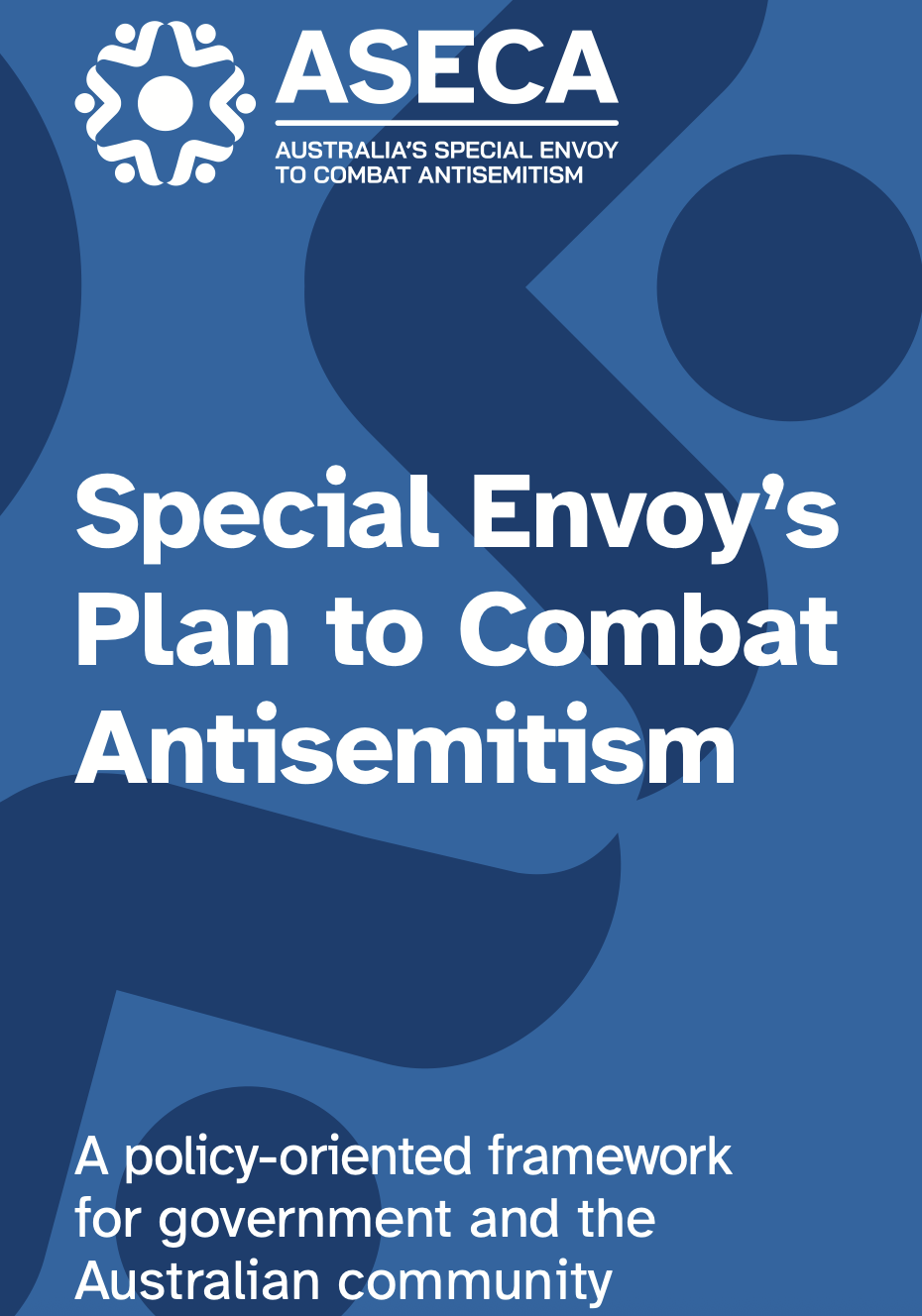
On 10 July, Australia’s Special Envoy to Combat Antisemitism, Jillian Segal AO, appointed last year by the Albanese government, published her Plan to Combat Antisemitism. It has already come under attack from many quarters, especially for urging the nationwide adoption of a contested definition of antisemitism, and for its call for universities, researchers, cultural institutions, and public broadcasters to have their funding withdrawn if they encourage, or do not do enough to combat, antisemitism.
Among the more prominent targets of the Plan are the public broadcasters, which it proposes should be monitored by the Special Envoy who would “assist” them to avoid “distorted narratives” and to follow their own editorial policies.
Alumni director Jonathan Holmes argues that, if implemented, the Plan would simply exacerbate the pressure the ABC is under to avoid reporting truths that are unwelcome to the more vocal supporters of Israel.
This morning was a fine winter’s day in Sydney. I went for a walk, as I often do, along the coast path near my home in Clovelly, listening, as I often do too, to an episode of The Rest is History podcast, presented by English historians Tom Holland and Dominic Sandbrook. This one is called “The Body in the Woods; A Medieval Murder Mystery”.
It concerns a 12-year-old boy discovered brutally murdered and hanging in a tree in a wood near Norwich in 1144. He was probably the victim of a roaming gang of robbers, who were common at that place and time. But in the next few years, the blame for young William’s murder fell on the Jews of Norwich.
An account by a Welsh monk called Thomas of Monmouth, The Life and Miracles of St William of Norwich, sounds harmless enough. But as Holland puts it, “it is one of the most sinister, poisonous and influential texts ever published in England”, one of the origins of the grotesque myths about the Jews that spread through western Europe in the ensuing centuries: dark tales of child torture and ritual sacrifice, and the lust for Christian blood; conspiracy theories that lay behind countless pogroms and expulsions up to and including the Holocaust that consumed the Jews of Europe less than a century ago.
It was pertinent listening for a non-Jewish person who was thinking about the recently published Plan issued by Australia’s Special Envoy to Combat Antisemitism, Jillian Segal AO. Antisemitism is, she states repeatedly, “the world’s oldest hatred”. It is also one of the darkest. It persists to this day, in conspiracy theories such as QAnon, peddled on the internet for all to read.
For Jews all over the world for whom the state of Israel is a potential refuge from such evil, it is all too easy to believe that any criticism of the Jewish state is motivated by, or at least fans, that ancestral hatred of the Jewish people.
An example from my own experience. I arrived from Britain to become Executive Producer of Four Corners in April 1982. In June of that year, Israel invaded its northern neighbour Lebanon. The operation successfully expelled the Palestine Liberation Organisation from Beirut, at the cost of many thousands of civilian casualties. Soon after the attack began we made a program called, perhaps somewhat provocatively, David and Goliath. In the program, several experts predicted – accurately, as it turned out – that Israel would become enmeshed in a conflict from which it would be hard to withdraw.
The following week a deputation from the Jewish Board of Deputies in Sydney asked to come and see me. They were most unhappy with the program. They said it was biased against Israel. I disagreed. After perhaps 20 minutes of increasingly vehement argument, one of them said that the program, and I, were antisemitic. I asked the deputation to leave, and they did.
To any ABC journalist or editor who has had anything to do with the coverage of the Middle East in the past five or six decades, that will be a familiar experience. The Jewish-Australian community has produced numerous organisations whose main pre-occupation seems to be monitoring the media’s coverage of Israel on the lookout for ‘bias’.
Any factual error, any perceived favouring of the Palestinian, or Lebanese, or Iranian, or Egyptian, or Arab, or Islamic perspective in the endless conflict is leapt upon. Complaints are made to the highest quarters, apologies or corrections are demanded; individual reporters and presenters are targeted.
The ABC’s current America’s Editor and former Global Affairs editor John Lyons wrote a whole book about the experience: Dateline Jerusalem: Journalism’s Toughest Assignment. As The Australian’s Jerusalem correspondent for six years, he was routinely targeted by Jewish-Australian lobbyists and robustly defended by its then editor-in-chief, Chris Mitchell. His short book, as the blurb bluntly puts it, describes “how journalists who accurately report what they see can be hounded and vilified, part of a practice of intimidation, harassment and influence-peddling that is designed to stop the truth from being told.”
All too often, the accusation of antisemitism is made against those individuals, and even the media outlets they work for. Those organisations – among them, the ABC – have, all too often, been cowed or intimidated. The most recent example is the illegal removal from her on-air duties of Antoinette Lattouf, not for anything she said on air but for her social media activity before as well as during her one-week engagement by the ABC. Federal Court Justice Darryl Rangiah, in his judgment (par 603), said she was effectively dismissed following a single controversial Instagram post, in part at least, “to appease the pro-Israel lobbyists who would inevitably escalate their complaints about the ABC employing a presenter they perceived to have anti-Semitic and anti-Israel opinions”.
So it is not surprising that Jillian Segal’s Plan to Combat Antisemitism has caused alarm within the ABC (though I’m not aware of any public statement about the Plan by the Corporation itself).
Segal is the immediate past president of the Executive Council for Australian Jewry (The ECAJ), which purports to represent the Jewish community as a whole. That is no doubt why she has been appointed by the Albanese government as its Special Envoy to Counter Antisemitism.
The ECAJ is one (among many) of the Jewish organisations that has been active in, as they see it, holding the ABC’s reporting to account. [I should except from this generalisation the recently-formed Jewish Council of Australia, which represents those many Jews who oppose the actions of the Netanyahu government and which has already strongly condemned the Segal Plan.]
In her report, Segal makes many startling claims, all of them without any evidence or reference. For example, that “antisemitism is evident within schools and universities and has become ingrained and normalised within academia”. Ingrained and normalised? Antisemitism? Really? Examples? Not one.
The recent alarming rise in antisemitism in Australia, Segal claims, has been “driven by conflict in the Middle East, manipulated narratives in the legacy and social media…”
No examples of a “manipulated narrative” in the mainstream media that has driven antisemitism is offered by Segal in her Plan. She declined to offer one to Sarah Ferguson on 7.30 on the evening of the Plan’s publication, despite frequent requests.
The next morning, pressed again by Steve Cannane on Radio National Breakfast (at 01.41.15) she came up with one – a strike on a hospital in Gaza “about six months ago”. According to Segal, the ABC reported “as fact” that it had been bombed by Israel, “people were upset and the Jewish community was looked at with disgust … and then it turned out indeed that it was not bombed by Israel but was a bomb from Gaza itself [she meant a Hamas rocket] that had fallen short – the ABC reported it in great detail and repeatedly, and then the correction as always is very, very, very small.”
That incident was not six months ago, but in October 2023, near the very beginning of Israel’s riposte to the October 7th Hamas atrocities. Not 6, but 21 months ago. And as anyone who reads the ABC Ombudsman’s careful analysis of the incident can see, Segal’s description of the ABC’s behaviour is a travesty of the truth. The ABC ran the Israeli government’s denial of responsibility within an hour of its first report alleging an Israeli air strike – an allegation attributed to the Gazan authorities, not stated as fact, and derived from a Reuters report that did the same. Every subsequent report on the ABC made clear that the claim that it was an Israeli strike was highly contested. The Ombudsman found no breach of the ABC’s editorial policies on either accuracy or impartiality.
Yet this, Segal told Steve Cannane, is a prime example of a “manipulated narrative in the legacy media” that has helped to drive the rise of antisemitism.
She does not, of course, acknowledge in her Plan that the many Israeli strikes on hospitals as well as civilian residences, and more recently on people queuing for food and supplies in Gaza – attacks that have been responsible for tens of thousands of civilian deaths – may have had something to do with “people being upset”, and with the Jewish community in Australia being “looked at with disgust”.
In most cases the IDF has claimed that Hamas was using the cover of hospitals to conduct its military activities or to store munitions – claims invariably reported by the ABC. The claims may well be true. And in any case, there is no excuse for the opponents of Israel targeting Jewish people in Australia in any way. Any more than there was any excuse, following Islamist terrorist attacks in Bali or Martin Place, for people in Australia targeting and abusing Muslim residents.
Of course, such abuse is encouraged and perpetuated in the nastier depths of social media. “Major vectors of hate”, Ms Segal calls them, and she is urging much stricter regulation to combat it – though that is a task that governments around the world are struggling with, to little effect so far.
But Segal insists that the “legacy” media, and especially the public broadcasters in Australia, are part of the problem too. To combat antisemitism, Ms Segal’s Plan insists, “publicly funded media organisations should be required to uphold clear editorial standards that promote fair, responsible reporting to avoid perpetuating incorrect or distorted narratives or representations of Jews.”
Well, the ABC and SBS already have clear editorial standards, and even more extensive guidelines, that go far beyond anything the commercial media are required to abide by. It is true they do not focus especially on antisemitism, but they certainly cover – at length – racist and religious prejudice and ‘hate speech’.
An extract from that Guideline:
There are identifiable patterns that can help distinguish hate speech and prejudice from legitimate debate.
For instance, the point at which legitimate criticism of the state of Israel and the actions of some Israelis becomes anti-Semitism reveals itself when the target becomes ‘Jews’ rather than ‘Israel’.
It cuts the other way too, when legitimate criticism of Hamas or other Palestinian groups becomes denigration of ‘Arabs’.
But those standards are not, it seems, adequate. The Plan insists that the public broadcasters need the help of the Special Envoy (that is, of Jillian Segal AO) “to encourage accurate, fair and responsible reporting and assist them to meet their editorial standards and commitment to impartiality and balance and to avoid accepting false or distorted narratives.”
No, Ms Segal, the ABC does not need your help in meeting its own editorial standards, especially on the coverage of the Middle East. The ECAJ, and many other such organisations, have been providing that ‘help’ for decades. As a general rule, their standards of impartiality and balance are not the ABC’s, because they are coming from one side of a highly contested debate.
Many – including ABC reporters who have worked or are working in the Middle East – would argue that their narratives are not infrequently “distorted” by pressure from their own bosses in Sydney or Melbourne who are all too conscious of the power of the “Israel lobby”.
Of course, those groups have every right to express their views to the ABC. But to have such advice given the imprimatur of a government-appointed Special Envoy, backed by the not-so-veiled threat that the ABC’s funding may be at stake, would be an over-reach that would imperil the ABC’s independence and its reputation for impartiality.
Antisemitism in its ancient, mythologised form is an evil which should be combatted. That it has been given new life by the horrible conflict now raging between Israel and its neighbours is incontestable. In the unlikely event that this misguided Plan were implemented, it would arguably only fan the flames, by lessening the trust that the Australian public as a whole still reposes in its public broadcasters.
Jonathan Holmes
July 2025
Jonathan Holmes began his career with the BBC in 1969, working as a producer on current affairs programs like 24 Hours, Nationwide and Panorama. In 1982 he was invited to Australia to become executive producer of ABC’s Four Corners. He never returned to the UK and has since served as Head of ABC Documentaries, as executive producer of Foreign Correspondent and The 7.30 Report, as an on-camera reporter for Four Corners and Foreign Correspondent, and for two years as an ABC correspondent in Washington DC (1998- 2000). He is perhaps best known for his five years as presenter of Media Watch (2008-2013). He continues to write on media affairs and is the author of On Aunty (2019).